Mastering uniform shirt sizing and fit selection is the cornerstone of a successful enterprise corporate apparel rollout. While fabric quality and logo embroidery establish your brand identity, garment fit determines whether your team feels confident and comfortable performing their daily duties. Sizing errors represent one of the most expensive hidden pitfalls in bulk garment procurement.
📌 Table of Contents
- Why Sizing Errors Are the Hidden Cost in Bulk Uniform Orders
- How Do You Size Uniform Shirts for a Whole Team? (Direct Answer)
- Collecting Sizes Without Measuring Everyone Individually
- Building a Balanced Size-Run Ratio Breakdown
- How to Read a Uniform Shirt Size Chart (Chest, Length, Sleeve)
- Best Practices for Uniform Shirt Sizing Across Large Teams
- Fit Types — Classic vs Slim vs Relaxed for Uniforms
- Apparel Size Tolerances: What Variance is Normal in Production?
- How to Avoid Costly Reorders (Buffer Stock & Fit Sets)
- Frequently Asked Questions
Why Sizing Errors Are the Hidden Cost in Bulk Uniform Orders
When purchasing enterprise apparel in volume, a single sizing mistake propagates across hundreds of garments. If 15% of your staff receive ill-fitting shirts, your organization faces immediate financial penalties: emergency small-batch reorder costs (which incur higher unit prices), custom alteration expenses, delayed onboarding, and reduced employee morale. Furthermore, returning custom embroidered shirts is rarely permitted by garment manufacturers, turning mis-sized inventory into immediate dead stock.
In addition, ill-fitting apparel creates a negative impression on customers. Employees wearing oversized, baggy dress shirts appear unkempt, while overly tight shirts restrict arm mobility and lead to seam tearing at stress points like the shoulders and back armholes. Standardizing your approach to uniform shirt sizing mitigates these operational liabilities before bulk production begins.
How do you size uniform shirts for a whole team?
How do you size uniform shirts for a whole team?
Direct Answer: To size uniform shirts accurately for a large workforce, collect actual chest and collar measurements using a standardized measuring tape, cross-reference them against the factory’s garment spec sheet, build a balanced size run breakdown ratio (typically 1-2-2-1 for S-M-L-XL), and utilize a physical sample try-on sizing set prior to finalizing bulk production.
Collecting Sizes Without Measuring Everyone Individually
In large corporate or multi-location teams, measuring every employee in person is logistically impossible. To streamline size collection when ordering uniform sizes for a team across multiple branches:
- Issue Garment Comparison Guidelines: Instruct employees to lay their best-fitting personal dress shirt flat on a table and measure flat across the chest (armpit to armpit), doubling that number for total body circumference.
- Use Digital Self-Reporting Forms: Provide a standardized online portal with visual diagram instructions showing where to measure chest, neck collar, and sleeve length accurately.
- Deploy Sample Sizing Kits: Request a physical “sizing ring” or blank sample set from your supplier for regional managers to conduct swift fit sessions during team meetings.
Building a Balanced Size-Run Ratio Breakdown
When ordering initial inventory buffer stock or ordering for prospective hires without named employee lists, enterprise buyers rely on demographic statistical size bell curves. Proper uniform shirt sizing management requires allocating inventory according to historical workplace averages. A standard corporate size-run distribution across 100 shirts typically follows this ratio model:
| Small (S) | Medium (M) | Large (L) | X-Large (XL) | 2X-Large (2XL) | 3XL+ Buffer |
|---|---|---|---|---|---|
| 10% – 15% | 30% – 35% | 30% – 35% | 15% – 20% | 5% – 8% | 2% – 5% |
Best Practices for Uniform Shirt Sizing Across Large Teams
Implementing successful uniform shirt sizing standards across enterprise organizations requires structured execution. First, establish clear distinction between unisex sizing and dedicated gender-specific cuts. Men’s dress shirts are engineered with wider shoulders and straight waist cuts, whereas women’s uniform shirts feature bust darts, curved waistlines, and shorter sleeve lengths to provide a flattering, professional fit.
Second, account for fabric shrinkage based on material composition. While 65/35 poly-cotton poplin fabrics shrink less than 1.5%, 100% cotton garments can shrink 3% to 5% after initial laundering. If your organization selects 100% cotton corporate shirts, advise staff members who fall between size boundaries to select the larger size category.
How to Read a Uniform Shirt Size Chart (Chest, Length, Sleeve)
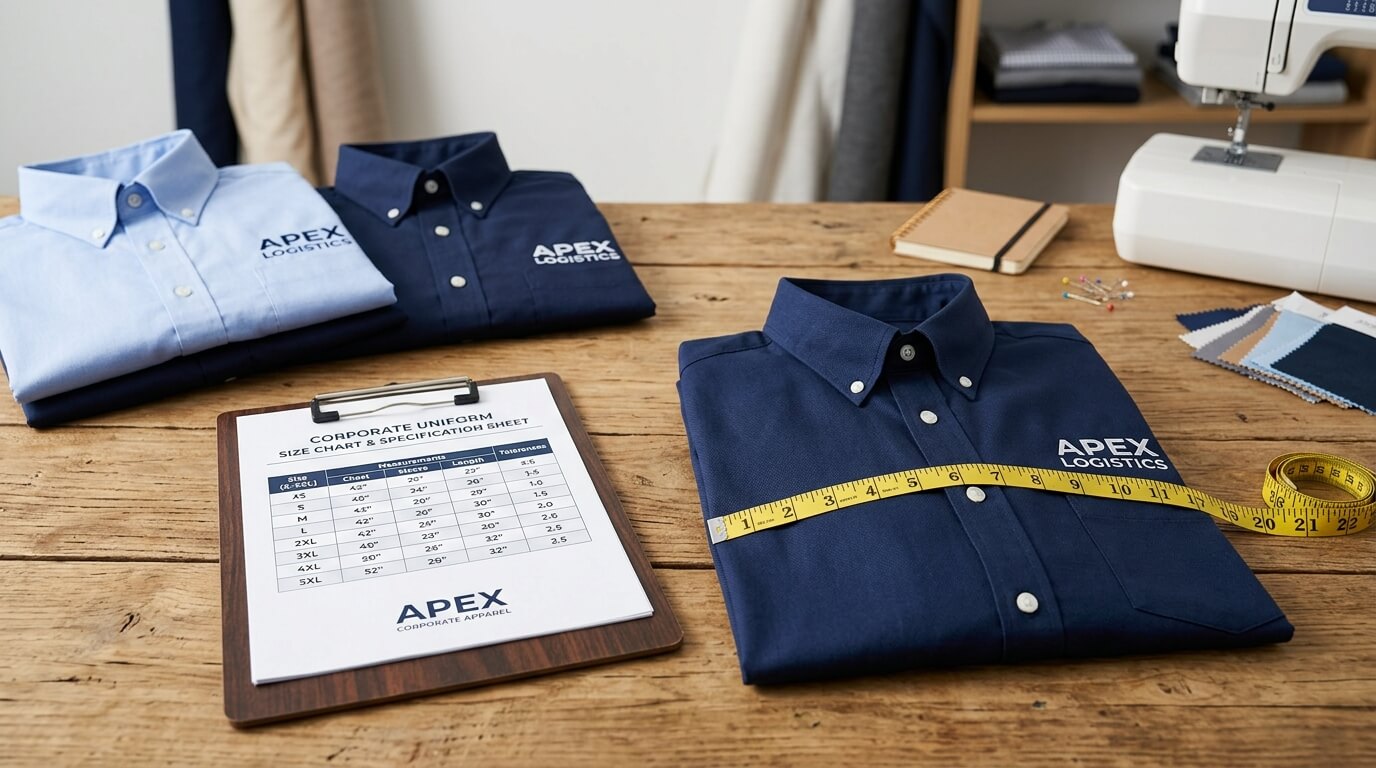
Reading a manufacturer’s bulk uniform size chart requires distinguishing between Body Measurements and Garment Flat Spec Measurements. Garment measurements include “ease”—the additional fabric room engineered into the shirt for comfortable daily movement.
- Chest Width (1/2 Chest): Measured flat 1 inch below the armhole seam across the chest. Double this number to determine total circumference ease (typically 4 to 6 inches wider than actual body measurement for mobility).
- Center Back Length: Measured from the base of the collar neck seam straight down to the bottom hem. Ensures shirts remain comfortably tucked in during active work shifts.
- Sleeve Length (Long Sleeve): Measured from the center back collar seam across the shoulder point down to the edge of the wrist cuff.
- Neck / Collar Size: Measured flat from the center of the collar button to the far end of the buttonhole (critical for corporate dress shirts worn with neckties).
Standard Corporate Uniform Shirt Size Chart & Measurements
| Alpha Size | Neck Collar (in) | Body Chest (in) | Flat Garment Chest (in) | Shirt Length (in) | Sleeve Length (in) |
|---|---|---|---|---|---|
| Small (S) | 14.0″ – 14.5″ | 34″ – 36″ | 21.0″ (42″ circ) | 30.5″ | 32.5″ – 33.0″ |
| Medium (M) | 15.0″ – 15.5″ | 38″ – 40″ | 23.0″ (46″ circ) | 31.5″ | 33.5″ – 34.0″ |
| Large (L) | 16.0″ – 16.5″ | 42″ – 44″ | 25.0″ (50″ circ) | 32.5″ | 34.5″ – 35.0″ |
| X-Large (XL) | 17.0″ – 17.5″ | 46″ – 48″ | 27.0″ (54″ circ) | 33.5″ | 35.5″ – 36.0″ |
| 2X-Large (2XL) | 18.0″ – 18.5″ | 50″ – 52″ | 29.0″ (58″ circ) | 34.0″ | 36.5″ – 37.0″ |
Fit Types — Classic vs Slim vs Relaxed for Uniforms
Selecting the right cut in your uniform shirt fit guide depends on your corporate image and workforce demographics:
- Classic Fit (Traditional Corporate): Generous cut across the chest, waist, and armholes. Provides maximum ease of movement and accommodates diverse body shapes effortlessly. Recommended for 80%+ of general workforce uniform programs.
- Modern / Tailored Fit: Slightly tapered through the waist and upper arms with reduced excess fabric. Delivers a sleek, professional silhouette ideal for hospitality front-desk, sales representatives, and executive staff.
- Relaxed / Workwear Fit: Extra boxy cut featuring extended tail length and roomier arm sockets. Designed specifically for active field technicians, maintenance crews, and industrial personnel who reach, bend, and lift constantly.
Apparel Size Tolerances: What Variance is Normal in Bulk Production?
During mass garment manufacturing, minor sizing variations occur naturally during fabric cutting and sewing. According to international garment standards such as ASTM apparel body measurement guidelines, standard acceptable apparel size tolerance for woven uniform shirts is ±0.5 inches (±1.27 cm) on flat chest and length measurements.
If a shirt’s spec sheet calls for a 23.0″ flat chest, any finished garment measuring between 22.5″ and 23.5″ is considered commercially acceptable and within international factory quality control limits. When auditing incoming bulk orders, inspect a random 10-piece sample per size batch to verify that production stays within these parameters.
How to Avoid Costly Reorders (Buffer Stock & Fit Sets)
Protect your corporate apparel budget against sizing surprises by establishing three operational safeguards during procurement:
- Order a 5% – 10% Safety Buffer Stock: Include extra un-embroidered Medium, Large, and XL shirts in your primary production run to absorb new employee hires and immediate size exchanges without incurring small-batch setup fees.
- Request a Physical Try-On Size Set: Order one unbranded sample set (S through 3XL) prior to bulk manufacturing so staff can test fits physically before customization.
- Review Pre-Production Sample Specs: Verify flat measurements on your pre-production fit sample against your tech pack before issuing formal bulk approval.
Frequently Asked Questions
How much size variance is normal in bulk uniform shirt production?
Standard commercial apparel production tolerance is ±0.5 inches (±1.27 cm) on flat garment measurements (chest, length, sleeve). Variances exceeding 0.75 inches indicate poor factory cutting quality control.
Should we choose classic fit or slim fit for corporate uniforms?
Classic fit is strongly recommended for general corporate uniform programs because it flatters diverse body shapes comfortably. Slim fit should be reserved for specific roles like executive staff or hospitality front-desk representatives.
How should enterprise buyers handle plus-size uniform sizing (3XL to 6XL)?
Verify that your manufacturer offers extended sizing with proportional grading adjustments (longer tail length and wider armholes) rather than simply expanding chest width, ensuring plus-size garments hang properly.
Do uniform suppliers provide physical sample try-on size sets?
Yes. Professional uniform manufacturers supply un-embroidered size-run sample sets (S through 3XL) for corporate clients to run employee fit-testing sessions before finalizing bulk order breakdown ratios.
How do we calculate buffer stock for new employee rollouts?
Maintain an additional 5% to 10% unassigned inventory ratio weighted toward central sizes (Medium and Large). Un-embroidered buffer stock can be quickly decorated locally or at the factory for new hires.
Related Reading: Learn how to choose a uniform shirt supplier or review our comprehensive guide on selecting corporate uniform shirt fabrics.
Get a Customized Size-Run Breakdown & Fit Sample Set
Unsure about your team’s size distribution ratio? Send us your staff headcounts for a tailored size-run recommendation and dispatch a physical sample try-on set to your office.