
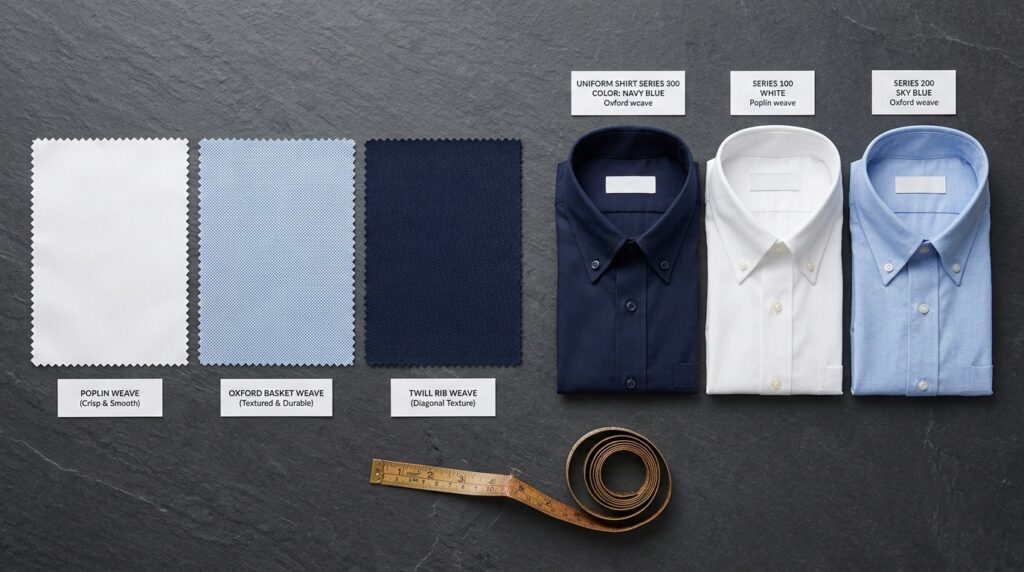
What Are the Best Uniform Shirt Fabric Blends for Commercial Workforces?
The best uniform shirt fabric blends balance fiber strength, breathability, and laundry resistance. For corporate office environments, a 65/35 polyester-cotton blend woven in a 115 to 135 GSM poplin or pin-point oxford offers maximum wrinkle recovery and color retention across 50 commercial wash cycles. Industrial and utility crews require a heavier 180 to 215 GSM twill weave to resist tearing and surface abrasion.
When procurement directors evaluate bulk garment orders, selecting the right yarn construction prevents expensive program failures. A shirt that looks crisp on sample day can pill, shrink past sizing tolerance, or trap body heat if the fabric composition fails to match the actual job function. In high-volume corporate apparel programs, the fabric blend accounts for over 55% of the total unit manufacturing cost and dictates more than 80% of employee wear complaints.
Why Competitor Fabric Guides Fail B2B Buyers
Most commercial uniform articles give generic consumer advice. They state that cotton is breathable and polyester is durable, then leave buyers to guess actual yarn counts, weave constructions, and laboratory testing benchmarks. They omit the financial calculations that separate a successful three-year uniform contract from a procurement disaster.
If you purchase 5,000 corporate shirts in 100% carded cotton at 110 GSM because the unit price was fifty cents lower, your business will pay triple that initial saving in replacement cycles. Carded cotton frays at the collar tips within twenty washes, loses dimensional shape, and requires intensive industrial steam pressing after every shift. A properly engineered poly-cotton or combed CVC blend costs slightly more per meter at the mill, yet slashes annual replacement budgets by half.
The True Economics of Uniform Fabric Selection: Cost-per-Wear Math
Experienced procurement officers evaluate garments by cost-per-wear rather than initial purchase price. The formula is straightforward:
Cost Per Wear = (Initial Garment Cost + Total Laundering Expenses) / Total Usable Shifts
Consider a practical comparison across an enterprise workforce of 500 uniformed employees over a 24-month program period:
| Metric | Budget 100% Cotton (120 GSM) | Standard 65/35 Poly-Cotton (135 GSM) | Premium CVC 60/40 (145 GSM) |
|---|---|---|---|
| Initial Unit Factory Cost | $11.50 | $12.80 | $14.20 |
| Average Lifespan (Wash Cycles) | 28 to 35 Washes | 75 to 90 Washes | 60 to 75 Washes |
| Annual Replacement Rate | 3.2 Shirts per Worker | 1.4 Shirts per Worker | 1.7 Shirts per Worker |
| Wrinkle Recovery Performance | Poor (Requires Pressing) | Excellent (Wash-and-Wear) | Very Good (Low-Iron) |
| Color Fastness (After 40 Washes) | Visible Fading (Delta E > 3.5) | Sharp Retention (Delta E < 1.2) | Stable Retention (Delta E < 1.8) |
| Net 2-Year Cost per Employee | $73.60 | $35.84 | $48.28 |
The standard 65/35 polyester-cotton blend saves over 51% in total operational replacement costs compared to lightweight pure cotton. Understanding these dynamics allows procurement directors to defend fabric choices with concrete balance-sheet metrics.
The 4 Fundamental Fabric Blends Broken Down
Commercial shirting mills combine natural and synthetic filaments to engineer target performance profiles. Below are the four standard fiber formulations used in international corporate apparel manufacturing.
1. 65/35 Polyester-Cotton (The Commercial Workhorse)
Composed of 65% polyester staple fiber and 35% combed cotton, this blend represents roughly 60% of all commercial workplace button-down shirts globally. The polyester core provides extreme tensile resistance, preventing tearing at stress points like the armhole seams, side vents, and pocket corners. The combed cotton fiber wraps around the yarn surface, ensuring adequate moisture absorption against the wearer skin.
This blend maintains dimensional stability up to 60 degrees Celsius wash temperatures. It resists industrial alkaline detergents and recovers from creasing within minutes of hanging. It is the premier selection for security staff, transport operators, facility maintenance teams, and high-turnover retail crews.
2. Chief Value Cotton / CVC (60% Cotton, 40% Polyester)
Chief Value Cotton places natural cotton as the majority fiber by weight. By blending 60% long-staple cotton with 40% high-tenacity polyester filament, mills achieve the natural drape, matte appearance, and skin breathability of cotton while retaining the anti-shrink benefits of polyester.
CVC eliminates the synthetic sheen that sometimes plagues high-polyester fabrics under bright office fluorescent lights. It is the preferred choice for customer-facing branch banking staff, hotel reception teams, estate agents, and upscale automotive dealership sales personnel.
3. 100% Long-Staple Combed Cotton (Two-Ply Construction)
Pure cotton has an undeserved reputation for poor uniform durability, largely because cheap suppliers quote single-ply 30s or 40s carded yarns. When 100% cotton is specified correctly using long-staple Egyptian or Pakistani cotton in a two-ply combed yarn (such as 80/2 or 100/2), the result is exceptionally strong, luxurious, and breathable.
Two-ply means two individual yarn filaments are twisted together before weaving. This double twist locks fiber ends into the yarn core, eliminating surface fuzz and resisting pilling. Two-ply pure cotton is the ideal choice for C-suite executive staff, fine-dining sommeliers, and private hospital physicians who work exclusively in climate-controlled spaces.
4. Cotton-Elastane Blends (Performance Stretch Wovens)
Modern field roles demand mechanical mobility. Adding 3% to 5% Spandex or elastane into a 95% cotton or 65/32/3 poly-cotton-stretch base creates 2-way crosswise elasticity. Workers can reach, lift, and bend without the back yoke binding or collar buttons pulling sideways.
When specifying stretch wovens, ensure the fabric undergoes heat-setting stabilization at the mill. Unstabilized elastane degrades rapidly under high-heat commercial tumble dryers, causing the shirt hem to develop wavy, puckered edges.
Fabric Weave Architecture: Poplin vs Oxford vs Twill
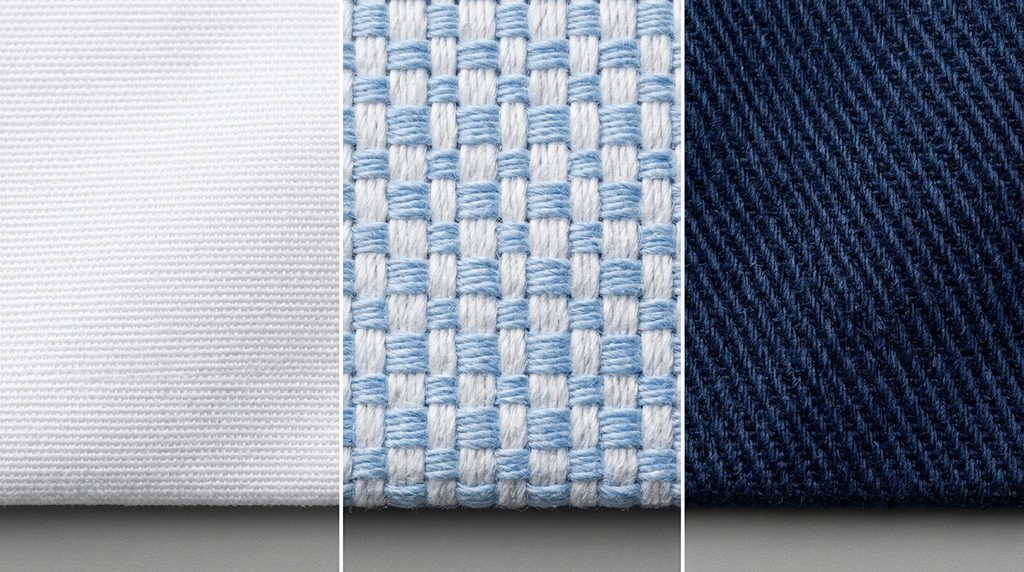
The weave determines how warp (vertical) and weft (horizontal) threads interlace. Two fabrics sharing the exact same 65/35 poly-cotton blend will feel, look, and perform completely differently depending on whether they are woven as poplin, oxford, or twill.
Poplin Weave (Plain Weave with Rib Effect)
Poplin, historically called tabinet, is a plain-weave construction characterized by fine, densely packed warp yarns crossing over heavier weft yarns. The warp yarn count is typically double the weft count (for instance, 100 ends per inch by 56 picks per inch).
- Visual Texture: Flat, smooth, crisp, and formal with zero surface fuzz.
- Air Permeability: Moderate to high, allowing airflow in temperate office settings.
- Embroidery Performance: Outstanding. The flat plain weave provides a stable base for high-density chest logos without puckering.
- Best Applications: Front-of-house corporate banking, healthcare administration, and pharmaceutical sales representatives. Explore our factory-direct high density Poplin uniform shirts for custom production runs.
Oxford Weave (Basket Weave)
Oxford cloth employs a modified plain weave called a basket weave. Two warp threads travel over and under two weft threads together. In traditional Oxford, dyed warp threads cross with unbleached white weft threads, creating the classic textured, heathered appearance.
- Visual Texture: Substantial, pebbled, and slightly textured with a relaxed business aesthetic.
- Air Permeability: Exceptionally high. The basket structure leaves micro-channels between yarn clusters, allowing heat to escape quickly.
- Wrinkle Masking: Superior. The pebbled surface naturally conceals minor creasing throughout an eight-hour shift.
- Best Applications: Universities, tech firms, sales consultants, and logistics supervisors. Review our custom custom Oxford uniform shirts for volume pricing and Pantone color matching.
Pinpoint Oxford Weave
Pinpoint uses the exact same basket weave as standard Oxford but uses much finer, higher yarn counts (such as 80/2 combed cotton). It bridges the gap between the casual durability of standard Oxford and the formal elegance of poplin. It is suitable for executive boardrooms and professional corporate settings.
Twill Weave (Diagonal Wale Lines)
Twill weaves interlace warp and weft yarns in a stepped progression, creating prominent diagonal parallel ridges called wales across the fabric face. Common variations include 2/1 twill and 2/2 herringbone twill.
- Visual Texture: Rich diagonal drape with a subtle surface sheen.
- Tear Strength: The highest of any shirt weave. Because threads float over multiple cross-threads, they pack tighter and absorb shearing forces without tearing.
- Stain Resistance: The diagonal ridges mask surface scuffs and minor spills far better than flat poplin.
- Best Applications: Aviation ground handling, field engineering, transport operations, and warehouse management. Discover our reinforced industrial workwear shirts designed for demanding physical workplaces.
Uniform Shirt Material GSM: Weight Selection Matrix by Climate
Fabric weight is measured in grams per square meter (GSM) or ounces per square yard (oz/sq yd). Specifying the incorrect weight creates immediate workforce friction. Shirts below 110 GSM become translucent under indoor lighting, while shirts above 185 GSM cause complaints about overheating in centrally heated offices.
| GSM Range | Fabric Category | Standard Yarn Count | Recommended Climate & Setting |
|---|---|---|---|
| 105 to 120 GSM | Ultralight Poplin | 50s single or 80/2 combed | Hot, humid tropical zones, Middle East GCC summer apparel |
| 125 to 140 GSM | Standard Commercial Poplin | 45s single CVC or 65/35 | Four-season indoor office environments, banking, healthcare |
| 145 to 165 GSM | Medium Pinpoint & Classic Oxford | 40s/2 or 21s single basket | Year-round corporate wear, universities, hospitality front-of-house |
| 170 to 195 GSM | Heavy Oxford & Midweight Twill | 16s single or 32/2 twill | Cool temperate zones, transport staff, security uniforms |
| 200 to 230 GSM | Industrial Workwear Drill/Twill | 20×16 3/1 heavy twill | Field engineers, industrial maintenance, oil and gas utilities |
Technical Procurement Specifications for Your Tech Pack
When issuing a Request for Proposal (RFP) to overseas apparel factories, never write ambiguous descriptions like “high-quality blue fabric.” Suppliers will inevitably choose cheaper yarn lots and lower density settings to win on price. Instead, paste these specific laboratory standards into your commercial contracts:
- Dimensional Stability to Washing (ISO 6330): Warp shrinkage must not exceed 2.0%; weft shrinkage must not exceed 1.5% after five consecutive 60-degree Celsius commercial wash cycles.
- Color Fastness to Artificial Light (ISO 105-B02): Minimum Grade 5 on the blue wool scale to prevent sunlight fading across outdoor shifts.
- Color Fastness to Perspiration (ISO 105-E04): Minimum Grade 4-5 on the grey scale for both acidic and alkaline conditions to stop underarm discoloration.
- Tensile Strength (ASTM D5034 Grab Test): Minimum 65 lbs warp and 50 lbs weft breaking force under official ASTM International fabric test methods to guarantee seam integrity under physical exertion.
- Pilling Resistance (ISO 12945-2 Martindale Method): Minimum Grade 4 after 2,000 revolutions to verify that friction from seatbelts and laptop bags will not generate unsightly pills.
- Certified Chemical Safety: All woven fabrics, dyes, and interlinings must comply with OEKO-TEX Standard 100 Class II requirements, verifying zero carcinogenic amines, heavy metals, or free formaldehyde. Review our certified factory ethical compliance audits for SEDEX and ISO 9001 documentation.
Collar Architecture, Interlining, and Stitch Precision
Even the finest fabric blend will fail if collar assembly is compromised. In commercial laundries, high water heat and rotational spin test the bond between outer fabric and internal stiffeners.
Woven vs Non-Woven Interlining
Budget apparel manufacturers cut costs by using non-woven glued paper interlinings. After three industrial washes, the adhesive breaks down, creating unsightly bubbles, wrinkles, and curling collar points. Professional corporate shirts require top-tier woven fusible interlinings sourced from certified manufacturers like Wendler or Freudenberg.
For executive poplin shirts, specify a double-fused woven interlining with a soft brushed back against the neck. For casual oxford button-downs, choose an unfused, lightly stitched woven interlining to deliver a relaxed roll without stiffness.
Stitches Per Inch (SPI) Standards
Retail shirts often use 12 to 14 stitches per inch (SPI). Under repeated commercial wash cycles, low SPI seams stretch and allow thread pullouts. B2B corporate uniform shirts require a strict 18 to 20 SPI lockstitch using polyester-core spun threads (such as Coats Epic or Gutermann). High SPI lockstitching maintains clean, flat seams that resist puckering across years of daily use.
How to Test Fabric Swatches Before Placing a 1,000-Piece Order
Before signing off on pre-production golden seals or releasing bulk manufacturing deposits, conduct these four practical laboratory checks on the physical yardage swatches submitted by your factory:
1. The Absorbency Droplet Test
Place three drops of room-temperature water on the fabric face. On pure synthetic fabrics or poorly finished poly-cotton, water beads up like plastic for over 30 seconds. On properly processed 60/40 CVC or treated 65/35 blends, the water should disperse and absorb within 3 to 6 seconds. Fast absorption confirms natural wicking capability.
2. The Fist Compression Recovery Test
Gather a 25 cm swatch in your hand, squeeze as tightly as possible for 15 seconds, and release it onto a flat surface. High-grade 65/35 poly-cotton and pinpoint oxford fabrics release 75% of creasing within 20 seconds. If sharp, knife-like folds stay set into the weave, the fabric will require constant ironing throughout its operational life.
3. The Seam Slippage Bias Pull
Cut a 10 cm swatch diagonally across the 45-degree bias grain. Pull firmly with both hands. A high-density weave maintains thread alignment without gaps appearing between warp and weft yarns. If threads slide and expose mesh-like openings, buttons will rip out under slight tension.
4. The Bleach and Rub Fastness Check
Dampen a clean white cotton cloth with warm soapy water and rub firmly against the dyed uniform swatch twenty times. If dye transfers onto the white test cloth, the dye house failed to properly fix the vat dye pigments. Reject the lot to prevent shirts from bleeding onto client furniture or undershirts.
Sector Decision Guide: Which Fabric Fits Your Industry?
| Industry Sector | Recommended Blend | Weave Type | Target GSM | Key Operational Reason |
|---|---|---|---|---|
| Corporate Banking & Finance | 60/40 CVC or Two-Ply Cotton | Pinpoint Oxford or Poplin | 130 to 145 GSM | Matte finish, sharp collar posture, executive presentation |
| Aviation & Cabin Crew | 65/35 Poly-Cotton with 3% Stretch | Fine Poplin | 120 to 135 GSM | Cabin pressure comfort, crease recovery after 14-hour flights |
| Hotel & Hospitality Front Desk | 65/35 Poly-Cotton | Classic Oxford | 140 to 155 GSM | Resists repeated washing, masks wrinkles behind reception counters |
| Healthcare & Clinical Administration | 65/35 Poly-Cotton Anti-Microbial | High-Density Poplin | 125 to 135 GSM | Tolerates 60C thermal disinfection without color loss |
| Field Logistics & Engineering | 65/35 Poly-Cotton Heavy Twill | 2/1 Diagonal Twill | 190 to 215 GSM | Extreme tear resistance, hides mechanical grease and dust |
Frequently Asked Questions About Uniform Shirt Fabrics
Which uniform shirt fabric blend lasts the longest?
A 65/35 polyester-cotton blend woven in a twill or heavy oxford weave yields the longest operational lifespan. It regularly survives 80 or more commercial wash cycles without thread degradation, color loss, or dimensional shrinkage.
Why do white corporate uniform shirts turn grey or yellow over time?
Greying occurs when low-quality polyester fibers attract suspended dirt during washing cycles, or when optical brightening agents (OBAs) wash out of cheap cotton yarns. Specifying high-tenacity virgin polyester fibers and vat-dyed optical white cotton finishes prevents discoloration.
What is the minimum order quantity (MOQ) for custom-milled uniform fabric?
Most commercial textile mills require roughly 1,000 meters per custom dye lot, which translates to approximately 650 to 800 finished long-sleeve shirts. For orders utilizing factory running shades (such as white, light blue, navy, and charcoal), production runs can start at 500 to 1,000 pieces per style.
Can we add custom embroidery to lightweight 110 GSM poplin shirts?
Yes, but high-density embroidery designs exceeding 8,000 stitches require tear-away backing and stabilizer interlinings to prevent the thin poplin weave from puckering around the logo boundary.
Order Direct From a Vertically Integrated Uniform Shirt Factory
Choosing the correct uniform shirt fabric blend is the most consequential decision in your apparel procurement program. Fashion Villaz engineers, cuts, stitches, and exports commercial workwear and corporate uniform shirts tailored to precise international buyer tech packs.
Whether you require 1,000 custom Oxford button-downs for a regional branch network or 10,000 heavy-duty twill shirts for an industrial workforce, our manufacturing plant delivers verified quality. Request a direct factory quote today to receive physical fabric swatch cards and customized production pricing.